Landing page or corporate website: how to choose
Choose by your offer, buyer questions and sales process. Compare a landing page, corporate website and customer portal. Download a decision worksheet.
Let the buyer’s task define the format
A landing page suits an offer explained through one coherent enquiry journey. A corporate site supports different services, company information, work and documents. Repeated work with personal records needs a separately scoped portal. These parts can share one website.
Start with what a visitor needs to understand and do. Screen count, an attractive opening or a wish for a bigger site does not define that result.
Compare six conditions
- Offer
- Landing page: one coherent choice journey. Corporate site: distinct service areas with their own questions and terms. Service count alone is not the boundary.
- Decision materials
- A landing page arranges necessary evidence in one sequence. A corporate site gives services, work, documents and company facts their own place when buyers need to explore them separately.
- Visitor source
- A campaign may need its own destination. Distinct search needs can justify useful separate pages. Traffic source alone does not guarantee an outcome.
- Next action
- An enquiry, quote request or registration can work in either format. Scope a catalogue, basket, portal, calculator or CRM by its functions, regardless of the website label.
- Updates
- Who changes terms, adds projects and publishes documents? Regularly changing information needs agreed editing tools and roles, beyond a homepage layout.
- Growth
- List likely additions: services, languages, CRM or accounts. This helps define phase one and preserve URLs when the site grows.
Two choices and a real project
The following situations are illustrative. They show the decision method and are not client sales data.
- One new service
- A company tests one offer for a defined audience with clear terms, materials and an enquiry action. A landing page can be phase one. Complex functions and other areas are not included automatically.
- Several B2B areas
- Buyers need to find a service, relevant work and documents. Different areas need distinct explanations. A corporate site can organize these separate journeys.
- Personal result after an order
- Customers need their documents or fulfilment status. The public site explains the offer while a portal has its own roles, data and acceptance.
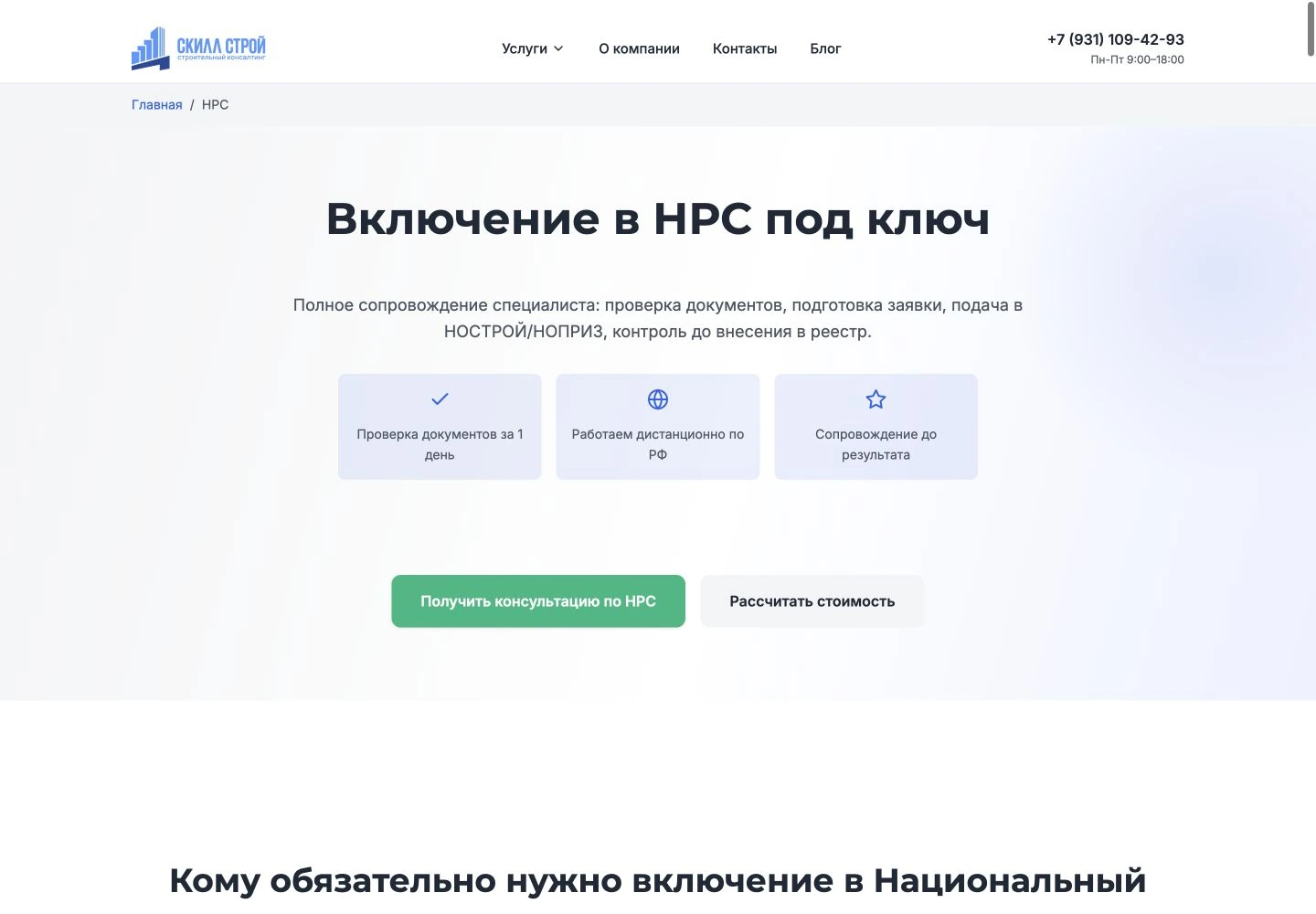
Скилл Строй presents construction consulting services and supporting materials through a corporate site. It is a real structural example. The Express collection shows focused offer pages. Delivery alone does not establish conversion performance.
Structure distinct questions clearly
Search needs useful answers, accessible pages and links. A landing page can cover one specific task; different services and conditions may need separate URLs. Creating many similar pages for volume is not a useful goal.
Google recommends logical navigation, informative headings and links to important pages. This guides structure rather than ranking corporate sites above landing pages by definition. Format and page count do not guarantee indexing, rankings or inclusion in AI answers.
Google: logical structure and internal links · SEO Starter Guide
Sources checked on 21 October 2026. The task-based format choice is BYstudio’s approach, not a separate search-engine requirement.
Define phase one before estimating
- Describe the offer, audience and pre-enquiry questions. Identify genuinely different buyer journeys.
- Choose the main action and enquiry handling after the website. List CRM, payment or accounts separately.
- Inventory ready and missing materials. Agree who prepares copy, images, work and documents.
- List phase-one pages, functions, exclusions and acceptance checks. A format name alone is not an estimate.
- Assign approval, editing and post-launch owners. Compare proposals against the same scope.
Download the format decision questions
How BYstudio scopes the work
Express covers a focused landing page for an agreed task. Its page publishes current price, timing, scope and start conditions. Corporate websites, stores, integrations and portals are estimated by their own scope. The initial review is free.
B2B website: structure and acceptance
Questions before choosing
Is a landing page always cheaper?
No. Content, design, functions, connections and acceptance determine scope. A complex calculator on one page may need more work than several simple sections. Compare the same deliverables.
How many services fit on a landing page?
There is no fixed number. Ask whether one buyer can understand the offer through one coherent journey. Different conditions, evidence and next actions may justify separate pages.
Can we start with a landing page and expand?
Yes. Agree the domain, URLs, materials and ability to add sections. Expand around actual tasks while preserving working URLs and enquiry intake.
Can a landing page attract search traffic?
It can answer a specific search need. Distinct services may need useful separate entry pages and links. Page count alone does not establish future traffic.
Do we need a landing page when we have a corporate site?
A focused service or campaign page can help when its visitor journey differs. It can live within the existing site. Avoid copies of one text for similar queries.
Is a customer portal included in a corporate site?
Only when separately agreed. Accounts need users, permissions, data, states and access support. Define their own first version even on the same domain.